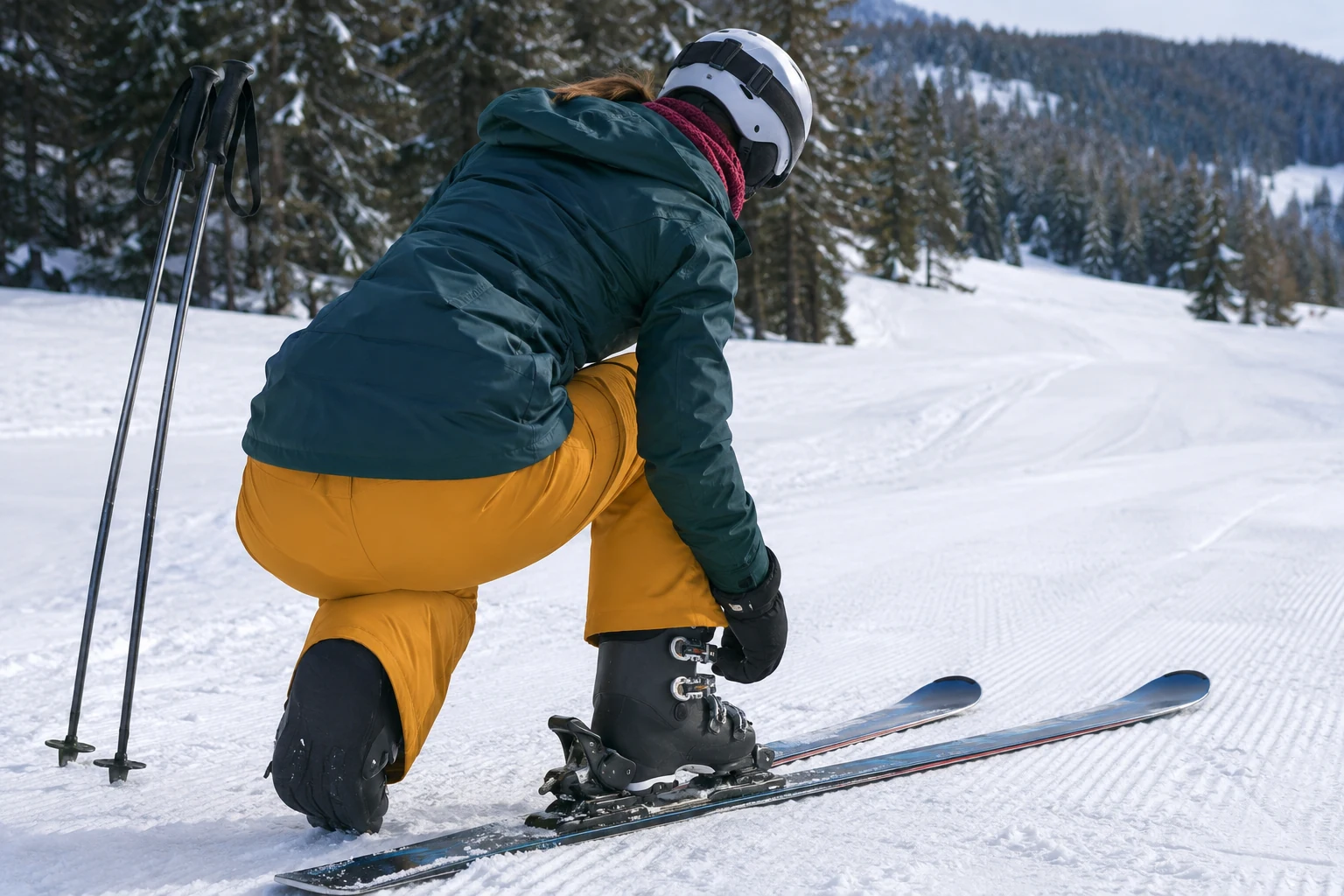
Try them on in your skiing stance
Skiing involves a constant change between upright and bent positions. You stand tall by the lift, bend to check a fastening and flex your knees on the descent. Protective shorts need to fit within those movements. You particularly notice layers getting in each other’s way around the waist and thighs.
At home, you can try the combination at your own pace. Put on all the layers you normally wear and bend your knees deeply a few times. Does the waistband still feel comfortable? Do the pads stay in place when you lean forwards? If you are considering a longer version, check the knee area and where the fabric meets your ski boot as well. Bunched fabric can be awkward there.
Shorts leave the lower legs free and may be easy to combine with clothing you already own. A longer version may add other padded zones; check the exact coverage of each model. Then choose according to fit and the stated use for skiing. Comfortable equipment is not necessarily about having the most components. It is about a combination in which everything has its place, leaving you free to concentrate on the next turn.
Sources and image credits: Demon United — Impact Padded Bottoms, Demon United — X V7 D3O A.I. Women’s Impact Shorts
The last few centimetres above your ski boot
Putting on ski boots reveals just how many layers gather around the lower leg. A sock, thermal base layer and long protective garment may each feel supple, yet their edges can take up considerable room together. Look at where each garment ends. How the layers should sit around your boot depends on that equipment and its instructions; there is no universal rule that every protective garment belongs inside or over the cuff.
Next, compare three positions: standing comfortably upright, leaning forwards and adopting your usual bent-knee skiing stance. Pay particular attention to the distance between waist and knee. If you keep pulling the garment higher to position the knee pad correctly, it is worth reassessing the cut and leg length. Tightening the waistband does not change that proportion. Shorts remove this link within the garment, but any separate knee equipment still needs its own fitting check.
Go through these positions with the thermal layer you actually expect to wear. If you use another layer on colder days, compare that combination separately. Long pants may form part of a warm outfit, but their length does not tell you which fabric or thermal properties the model has. Read the description of that version for those details.
A small change to the layers can make the difference in feel clearer. Change one garment at a time and repeat the same position. That helps show whether to focus on room around the boot, the outer trousers or the proportions of the protective pants themselves.
| Area | Check | What it means for your choice |
|---|---|---|
| Above the boot cuff | Do edges or folds feel intrusive? | Assess the layers together. |
| Around the bent knee | Does the pad stay at the intended height? | Compare leg length and cut. |
| At the waist | Does the garment pull down when you bend? | Check outer trousers and the thermal layer too. |
On a small screen, scroll this table horizontally. With a keyboard, focus the table region and use the arrow keys.