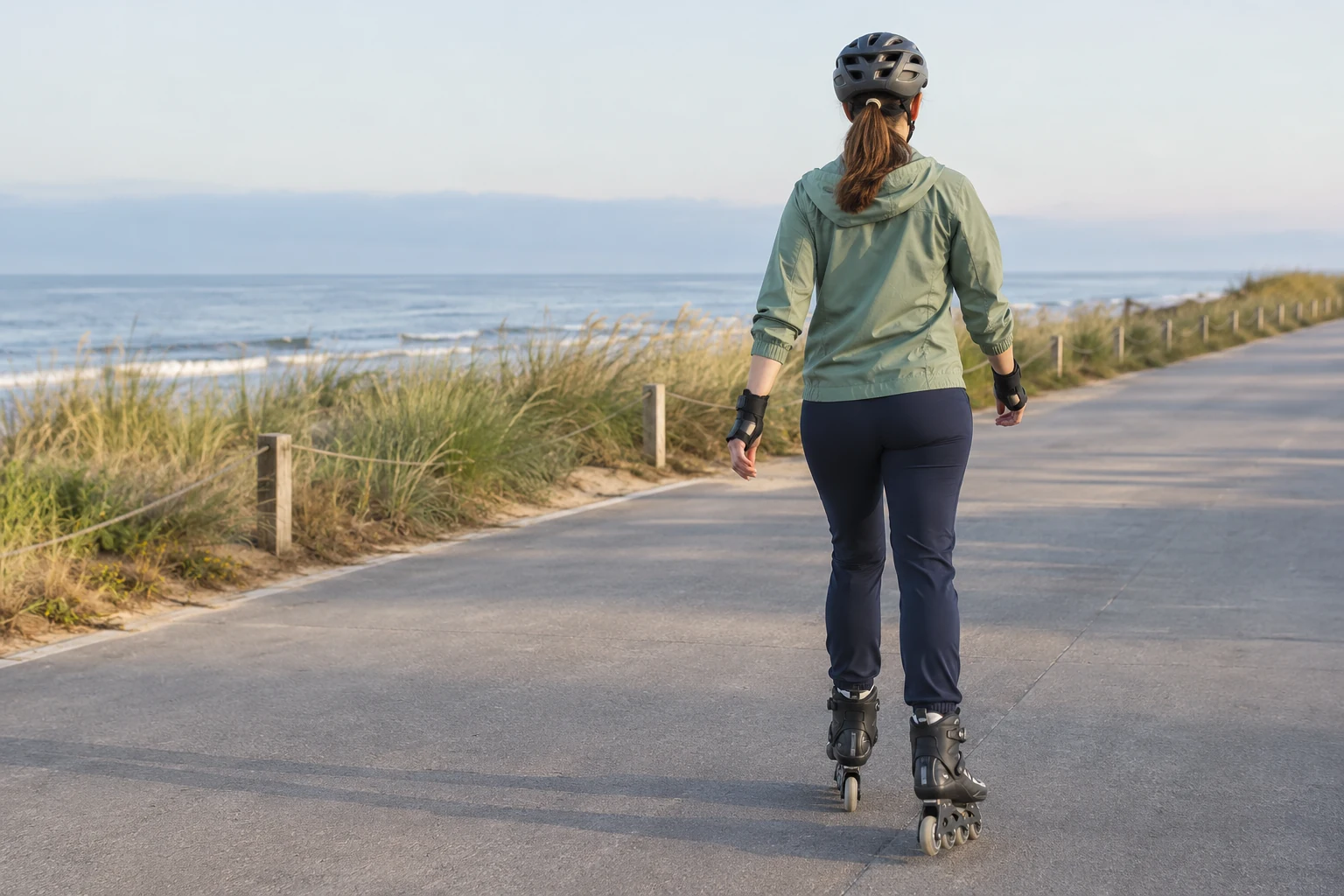
Let your clothing follow the movement
With each push, your leg moves outwards while your upper body stays relatively steady. The tension in the fabric around your hips changes a little each time. In padded shorts, you want to feel that the garment follows the movement without constantly needing to be pulled back into place.
Try a model suitable for this use under the trousers you actually intend to wear. The combination may be looser or closer than your winter sports clothing. Stand with your feet apart, bend your knees and slowly shift your weight. Check that the side panels stay put and the lower edge of the shorts feels comfortable. Choosing the size you normally wear in everyday trousers offers less guidance than the model's size chart and a proper fitting.
Also consider how much clothing feels comfortable on a mild day. Fabric, padding and outer trousers work together. A compact design can be useful, provided it covers the areas you want and suits the intended use. The shorts sit alongside your other appropriate skating equipment. When you set off, you want to focus on the route without first having to straighten a fold or a shifted waistband. A relaxed outing can stay relaxed.
Where the shorts end and the knee pad begins
At the start of a lap, you may mainly notice the waist; after a few gentle movements, the lower edge of the shorts becomes noticeable too. This is especially relevant with a separate knee pad that has a longer sleeve. During the fitting, look at where the two garments approach each other. An edge that sits clear when upright may rise or slide against the other layer as you bend.
Check the combination on the floor first, with your feet firmly on the ground. Bend your knees, straighten up and take a gentle sideways step. Then put on your outer trousers and repeat. If the shorts only move in this second round, that gives you a useful clue about the available space. Roomier outer trousers may feel pleasant, but they will not make an overly loose underlayer fit closely.
For a milder day, the whole clothing combination matters. Consider the fabric and padding you wear together and how they feel during ordinary movement. Thin-looking shorts do not tell you how warm they will feel; an open textile panel in a photograph does not tell you everything about the feel under outer trousers either. Compare actual versions without assigning them a general ventilation score.
You can then record your choice in one practical sentence: these shorts fit under my outer trousers and leave enough room for my existing knee equipment. Also check the intended skating use in the model information. That makes it easier to search later if you want to try another length, fastening or pad layout.
| Meeting point | What to look at | When to check |
|---|---|---|
| Shorts and knee sleeve | Whether the edges push each other upwards. | When bending and straightening again. |
| Underlayer and outer trousers | Whether the outer fabric pulls on the padding. | Before and after putting on the outer trousers. |
| Waist and upper clothing | Whether fabric doubles over. | In a low stance and while standing upright. |
On a small screen, scroll this table horizontally. With a keyboard, focus the table region and use the arrow keys.